
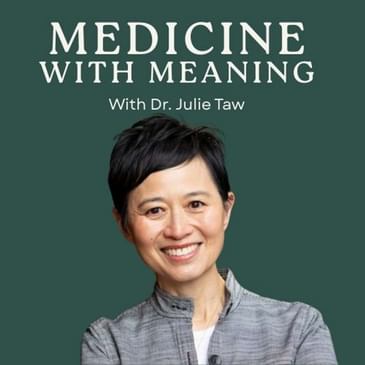
Welcome to Medicine with Meaning, where we dive into the science behind the everyday choices that impact our health and well-being. In today’s episode, we’re exploring a topic many of us know about from the perspective of relationships, but rarely consider as a foundation of physical health: boundaries. Host Dr. Julie Taw takes us through a thought-provoking conversation about how boundaries aren’t just a communication skill, they’re a biological necessity.
Together, we uncover how chronic overextension and constant availability can quietly affect our nervous system, increase stress hormones, and ultimately contribute to issues like fatigue, poor sleep, digestive troubles, and even hormone imbalance. You’ll hear Dr. Julie Taw share both clinical insights and personal experiences, shedding light on why boundary work is one of the most powerful forms of preventive medicine, especially for women and caregivers.
Whether you struggle with saying no, wrestle with guilt when protecting your time, or are curious about ways to support your body’s resilience, this episode will help you reframe boundaries as essential tools for healing. Tune in for practical advice, science-backed explanations, and empowering stories to guide you in setting limits that nurture your body and mind.
00:00 "Boundaries and Nervous System Health"
05:51 Women’s Caregiver Stress Cycle
08:16 "Biology or Conditioning in Women?"
12:01 "Learning Self-Worth and Growth"
16:13 "Practicing Boundaries for Well-Being"
19:07 "Feeling Good: Mind and Body"
22:39 "Guilt as a Nervous System Response"
26:09 "Boundary Overload and Stress Symptoms"
28:56 "Awareness to Heal and Align"
33:35 "Inner Self and Boundaries"
36:03 "Start with Small Protected Time"
40:21 "Reach Out for Support"
Boundaries as Preventive Medicine: Insights from Dr. Julie Taw on Medicine with Meaning
On the latest episode of "Medicine with Meaning," integrative physician and host Dr. Julie Taw to explores a topic that bridges our emotional and physical worlds: boundaries. But this wasn’t the familiar “how-to-say-no” conversation we often hear. Instead, Dr. Julie Taw offered a medical perspective on why honoring our personal limits is as vital to health as diet or exercise. Here are some of the key insights and takeaways from the conversation.
Boundaries: Not Just a Social Skill, But a Biological Need
We typically think of boundaries as tools for healthy relationships, but as Dr. Julie Taw explained, they’re fundamentally about how our bodies determine what’s safe and what’s too much. At a biological level, boundaries “live” in our nervous systems. When we constantly override our own needs, saying yes when we mean no, staying perpetually available, or over-giving, we send our bodies into a chronic state of threat. This keeps stress hormones like cortisol and adrenaline high, which disrupts sleep, digestion, immune function, and even hormones. As Dr. Julie Taw put it, “Boundaries aren’t just interpersonal, they’re physiological. In fact, they’re one of the most powerful forms of preventive medicine we have.”
How Chronic “Over-Doing” Shows Up in the Body
One of the most powerful reframes from the episode is that struggling with boundaries isn’t a character flaw or just a “people problem" it’s often a sign that your body has learned to ignore its own distress signals. Clinically, boundary overload looks like tension, insomnia, irritability, poor digestion, fatigue, anxiety, and inflammation. “The body isn’t broken,” Dr. Julie Taw explained, “it’s just adapting.” Learning to listen to these symptoms as cues for self-care rather than signs of failure is essential for healing.
Why Women and Caregivers are Especially Vulnerable
Many women and caregivers find themselves living on permanent “high alert,” struggling to prioritize their own needs. Dr. Julie Taw shared both personal and professional insights here, citing cultural conditioning and biological wiring. From early in life, women are encouraged to be helpful, available, and to equate worth with being needed. Over years or decades, this focus on others can make boundary-setting feel unfamiliar, even risky. “It’s not that we don’t understand boundaries,” Dr. Julie Taw said, “it’s that on a body level, setting them can feel dangerous, because we’ve learned that connection or safety comes from over-giving.”
Guilt: The Nervous System’s Growing Pain
Many people feel guilt when they begin to set boundaries. Dr. Julie Taw reframes this as a normal, even biological, response when our nervous systems have been trained to find safety in self-sacrifice. The key is to recognize guilt as a sign your nervous system is recalibrating, not a sign you’re doing something wrong. With time and practice, guilt will fade and be replaced by clarity, energy, and self-trust.
Practical Steps: Start Small, Start with Time
If you’re feeling overwhelmed, Dr. Julie Taw recommends starting with time-based boundaries rather than “saying no” to people right away. Carve out just 10 minutes of protected time each day, no emails, no requests, no multitasking, so your body gets the message that pausing is safe. Building this habit gradually helps calm the nervous system and builds self-trust, making other changes easier over time.
A Health Practice, Not a Personality Trait
Above all, boundaries should be seen as a health practice, not a personality trait. “They’re not about being rigid or difficult,” Dr. Julie Taw said, “but about giving your nervous system the conditions it needs to function well.” Sometimes the most healing thing you can do isn’t to add yet another habit, but to create more space for yourself.
This episode is a gentle but powerful reminder that your body is wise, and that learning to listen and respond to its boundaries is an act of healing. If you’re working on your health and feeling stuck, perhaps the answer isn’t in doing more, but in doing less and protecting the space needed for restoration.
Show Website - https://medicinewithmeaning.com/
Dr. Julie Taw's Clinic Website - https://julietawmd.com/
Dr. Julie Taw's Instagram - @julie.taw.md
Media/Podcast Partner: TopHealth - www.tophealth.care
“Disclaimer: Informational only. Not medical advice. Consult your doctor for guidance.”