
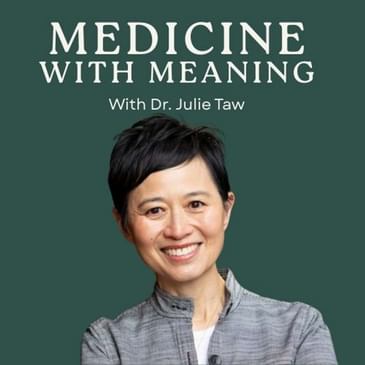
Welcome back to Medicine with Meaning! In this episode, Dr. Julie Taw invites you to step back and take a fresh look at what it truly means to age well. Instead of focusing solely on lifespan, the number of years we live. Dr. Julie Taw explores the more powerful concept of healthspan: the quality of those years, filled with vitality, independence, purpose, and engagement. Together, our hosts challenge common misconceptions about aging, reveal why midlife is a time for recalibration rather than decline, and discuss the foundational habits and mindsets that support well-being throughout life's decades. From daily routines and emotional resilience to the essential roles of meaning and community, discover how tending the ecosystem of your health can help you thrive, not just survive, as you grow older.
00:00 Defining healthspan vs. lifespan
05:31 Midlife health and recalibration
09:51 Broadening the concept of healthy aging
12:06 Understanding inflammation and resilience
14:50 Embracing and Riding Emotions
20:55 Understanding Blue Zones and Wellness
22:58 Measuring overall well-being in midlife
26:29 Balancing fitness and happiness
32:46 Importance of social connections
35:12 Importance of Social Connections
37:13 Seeing ourselves through relationships
40:46 Removing Drains for Better Health
44:02 Wrap-up and listener encouragement
Expanding Healthspan: Insights from "Medicine with Meaning"
On the latest episode of "Medicine with Meaning," Dr. Julie Taw dives into a transformative perspective on health, aging, and vitality, one that moves beyond the fixation on lifespan (the number of years we live) to emphasize healthspan: the quality of those years. Together with Ibre, the conversation illuminates what it truly means to age well and the small but significant shifts women, especially in midlife can make for a thriving future.
Redefining Midlife: From Decline to Recalibration
Much of the narrative around midlife is colored by ideas of inevitable decline. Dr. Julie Taw challenges this at 04:24, inviting listeners to see midlife not as a crisis but as a period of recalibration. After decades of caring for others and pushing through exhaustion, the body often signals that it’s time for change, not because it’s failing, but because it’s asking for new ways forward. The habits, environments, and relationships established in midlife become the foundation for vitality in later years.
Healthspan vs. Lifespan: It’s About Quality
As Dr. Julie Taw notes at 02:42, healthspan refers to the years spent living with “vitality, independence, purpose, and engagement,” not just surviving. Most people, she argues, don’t hope simply for a longer life but for one filled with energy, mental clarity, love, creativity, and purpose. It's a crucial distinction: true wellness is not the absence of disease, but the presence of vitality and the capacity to live fully.
Common Misconceptions About Aging
Aging, Dr. Julie Taw asserts, does not have to equal decline. Genetics play a role in our health, but our environment, relationships, stress levels, sleep, nutrition, and daily movement all influence how we age (08:20). Perhaps the most dangerous misconception is that enduring health is built through drastic changes. In reality, she emphasizes, healthspan results from ordinary choices basic, repeated, and consistent habits (09:09).
The Central Role of Resilience
A powerful theme in this episode is resilience, defined as the ability to adapt, recover, and thrive in the face of life’s inevitable challenges. Dr. Julie Taw highlights the nervous system’s impact: even with perfect diet and exercise, chronic stress and lack of recovery can undermine health (11:09). Cultivating resilience comes from honoring emotions, building supportive communities, nurturing purpose, and maintaining nervous system balance.
The Blueprint for Aging Well
What do resilient, thriving women have in common? It’s not a relentless pursuit of perfection. Rather, as Dr. Julie Taw shares at 16:44, these women prioritize steadiness over intensity. They value sleep, move regularly (but not excessively), adapt to change, nurture relationships, remain curious, seek joy, and listen to their bodies’ whispers long before those whispers turn into screams. The pursuit is not for an ideal body, but a meaningful, engaged life.
Health as an Ecosystem
One of Dr. Julie Taw’s most compelling metaphors is viewing health as an ecosystem, a web of interconnected systems. Everything from sleep and movement to nutrition, stress regulation, and relationships interacts to create our sense of well-being (28:06). Focusing on a single “fix” or isolated factor rarely works. Instead, tending to the entire ecosystem, much like tending a garden, yields the most rewarding results.
Purpose, Connection, and Meaning
Human beings are wired for connection, belonging, and meaning. Dr. Julie Taw reminds us that loneliness, isolation, and lack of purpose carry profound health costs (32:46). Relationships, community involvement, and meaningful engagement are biological necessities for thriving in later years. Our greatest growth, she notes, often happens through relationships, even the challenging ones.
Where to Start: Subtraction Over Addition
For those seeking a starting point, Dr. Julie Taw recommends not asking “What should I add?” but “What is quietly draining me?” (40:46). Instead of piling on new routines, she invites listeners to begin by subtracting chronic drains like sleep deprivation, digital overstimulation, or depleting relationships. True healthspan is shaped by creating environments that allow the body and life to recover, restore, and thrive.
Aging is inevitable, but decline is not. With consistent, compassionate tending to our ecosystem of health, we can build not just longer lives, but lives rich with meaning, connection, and vitality.
Show Website - https://medicinewithmeaning.com/
Dr. Julie Taw's Clinic Website - https://julietawmd.com/
Free Guide - https://go.julietawmd.com/reset
Dr. Julie Taw's Instagram - @julie.taw.md
Media/Podcast Partner: TopHealth - www.tophealth.care
“Disclaimer: Informational only. Not medical advice. Consult your doctor for guidance.”
Health span refers to the years we spend living with vitality, independence, purpose, and engagement in life. Because most of us aren't simply hoping for more years. We're hoping for more life within those years. We want to wake up with energy. We want to remain mentally sharp. Healthspan is not about extending life at all cost. It's about preserving the capacity to live well. I'm Dr. Julie Ta, and I'm so glad you're here. Over the past several episodes, we've explored many of the factors that influence our well-being, from stress and nervous system regulation to connection, energy, hormones, and the ways our bodies communicate with us. Today I'd like to zoom out and look at the bigger picture. We hear a lot about lifespan, how long we live. But what many women are really asking is how do I stay healthy, energized, independent, and engaged in the years ahead? That's where the concept of health span comes in. Health span isn't just about living longer, it's about living well. It's about supporting the physical, emotional, relational, and biological foundations that allow us to thrive throughout midlife and beyond. So today we're going to explore what truly matters when it comes to building a longer, healthier, and more meaningful life. Dr.
SPEAKER_00Julie, excited to get into this topic with you. So to start off, when you hear the term health span, what does it mean and how is it different from lifespan?
SPEAKER_01When people hear the word longevity, they often think about lifespan. So the number of years we live. Health span is something different. Health span refers to the years we spend living with vitality, independence, purpose, and engagement in life. Because most of us aren't simply hoping for more years. We're hoping for more life within those years. We want to wake up with energy. We want to remain mentally sharp. We want to continue contributing, learning, traveling, loving, creating, and participating fully in the lives of the people we care about. For me, health span is not about extending life at all cost. It's about preserving the capacity to live well. And I think that's an important distinction because health isn't simply the absence of disease, it's really the presence of vitality.
SPEAKER_00So as I'm understanding, is um lifespan speaks of quantity, whereas health span is quality, the quality within that quantity of years. And why is this conversation particularly important for women in midlife?
SPEAKER_01Well, midlife is often portrayed as a time of decline, but I see it differently. I see it as a period of recalibration. So many women arrive in midlife after decades of caring for everyone else, building careers, raising families, managing households, and carrying tremendous responsibility. So for years they've they may have been able to override exhaustion, ignore stress, and push through the body's signals. Then suddenly those strategies that once worked stop working. And this is where we experience changes like sleep, our hormones shift, stress feels differently, recovery changes, energy maybe less. So I don't see that this is the body failing. I view it as feedback. The body is asking for a new way forward. And that's why I call it, you know, a period of recalibration. And the habits, the environments, and the relationships we cultivate during midlife can profoundly influence how we feel in the decades that follow. So midlife is an important time to really start paying attention to our health. And if we're not feeling good in midlife, then our body's telling us that it's time to pay attention and find out what our body is asking for. And that can really help us in terms of how we age.
SPEAKER_00Thank you for reframing what midlife is. We do think that when we reach a s a certain age, we're just declining. And it always brings up the question for me: is it nature? Are we declining because that's nature, or because we've just spent too many years depleting ourselves through our lifestyle and just like overworking? And so I'm always curious about that, which leads me to my next question, which is what are the biggest mi misconceptions women have about aging and long-term health?
SPEAKER_01Yeah, I think one misconception is that aging and decline are synonymous, right? I think that's what you were alluding to. No, not necessarily. I think, you know, hopefully many of us can identify somebody in their 70s and 80s and 90s, even who appear vibrant and has good energy and feels good. Certainly aging is inevitable, but decline is influenced by many factors. So, you know, you can still feel vibrant, even it up into an old age. Another misconception is that long-term health is primarily determined by genetics. Certainly genetics matter, but they are only part of the story. The environments we create for our lives, the relationships we nurture, the stress we carry, the sleep we get or don't get, the food we eat, and the way we move our bodies. These all shape how those genetic tendencies express themselves. Perhaps the misconception that concerns me most is the belief that health is built through dramatic changes. In reality, health span is usually the result of ordinary choices repeated consistently over time. So the future is often shaped less by what we do occasionally and more by what we do every day.
SPEAKER_00I like that. Sustaining our health isn't really that dramatic. It's consistency over time. Has your own understanding of what it means to age well changed over the years?
SPEAKER_01Very much so. Certainly, earlier in my medical training, I probably viewed healthy aging primarily through the lens of disease prevention. Today my perspective is much broader. Certainly, I still care deeply about preventing chronic illness. But what I've come to appreciate is that aging well is about far more than avoiding disease. It's about preserving function and strength. It's about maintaining curiosity and continuing to learn. It's about staying connected to purpose. It's about being able to recover from life's inevitable challenges. And perhaps most importantly, I've become increasingly aware of the role the nervous system plays, right? We've talked a lot in this podcast about the importance of the nervous system. So we know a person can have excellent nutrition and exercise habits, but if they're living in chronic overdrive, constantly stress, disconnected from themselves, and never truly recovering, that's gonna affect the entire system. So I've become much more interested in what creates resilience than what simply prevents disease.
SPEAKER_00That's very interesting. And I think that perhaps as you create resilience, you also are kind of creating a shield that prevents disease. Like resilience also makes you stronger. Am I right?
SPEAKER_01Is it For sure. You know, we know that stress triggers inflammation in the body. We know that inflammation is the root cause of almost every chronic disease. And so if you're able to live in a way that does not promote inflammation, that is really key to disease prevention and of course longevity in that very simplistic sense, uh, reductionist sense, I should say. In that broader sense, you know, what do we mean by resilience? Gosh, this could be a whole podcast itself. I would say it's the ability to deal with the challenges of life. And certainly balancing our nervous system is key to that, right? But it's also about being able to recover when life is challenging, when there is a stressor. That's a another broader topic. How do we do that? Well, certainly honoring ourselves and our needs and taking care of ourselves, having support around us, connecting with loved ones that not only give us support in our life, but just, you know, help us regulate our nervous system, you know, feeling safe in those connections. And I would say that, you know, when we find meaning and connect with our purpose, you know, that is all part of building resilience. And the last piece is, you know, doing that in in community. Um, gosh, that was like a whole um tangent uh around longevity, but I would say resilience, building resilience is key to longevity. Right?
SPEAKER_00That does that make sense? That makes sense. And so what I'm getting is resilience is related to emotional strength, emotional For sure, yeah.
SPEAKER_01Meaning like our mental health is key to resilience. Our emotions are something that we want to recognize and honor and know that it is part of being human to experience emotions. But I think part of resilience is recognizing that our emotions they come and they go. It's like a river. Some days the river's like kind of stormy, but the river's constantly changing. And so recognizing that our emotions, they come and they go, and to learn to kind of ride the emotions and and not stay stuck in one emotion and not judging those emotions and recognizing that they pass, they often pass. And and if they don't, then that's when you stay stuck, and that's when you may want more support, either through friends and family or professional support. But yes, our emotions are part of how we build resilience.
SPEAKER_00And in your clinical work, Dr. Julie, uh what habits or patterns do you see most often in in women who remain healthy, resilient, and engaged as they age?
SPEAKER_01The women who age well are rarely the women pursuing perfection. Yay. They're the women who cultivate steadiness, they tend to prioritize sleep, they move consistently and not necessarily excessively, they maintain meaningful relationships, they adapt when life changes, they continue learning, they preserve a sense of curiosity, they make room for joy. When the body whispers, they pay attention, they don't wait until it has to scream. What stands out is not intensity, it's responsiveness. They work with their bodies rather than against them.
SPEAKER_00Oh, thank you for clarifying this. Many women should listen to this that you have just said about what patterns that women that age well usually follow, because I think that we're bombarded by all this information of what it is to take good care of health, and it's pretty different from what you just mentioned. It's always about doing more. And and sometimes I even question myself like, am I taking good care of my health? Like, am I doing enough? And you honestly just gave me a little bit of uh sense of ease.
SPEAKER_01Yeah, sometimes worrying about our health is counterproductive to health. And you're right, we are bombarded with so many things, you know, to do for health. And I know the whole field of longevity medicine is really exploding, and there are a lot of interesting new scientific developments. But, you know, if you look at the blue zones, which is often touted as um communities where people live into their 80s and 90s and beyond, and they're strong and vibrant and participating in the community, and they're not doing all the fancy things that we do in our society. And so they've been studied, you know, what are those factors? And there's, you know, there's different communities around the world, and each one has some unique characteristics, but um I think it does go back to some of the basic things that I just listed earlier. They're not fancy, they're not, I wouldn't say they're easy, but um they're basic. That's that's what I mean. Um and I think probably the biggest part of what connects all of the blue zones is probably community, that in each of these areas there's a rich community where families uh still live in close proximity, they have a more traditional lifestyle. Um and I think the elderly people, because they live in the community, feel a strong sense of purpose and meaning. They're connected to their families. They're helping out with, you know, the grandparents are helping with the grandchildren. Um, that's my take on why the blue zones thrive, and that is probably a common thread amongst the different cultures of the different blue zones.
SPEAKER_00Aaron Powell It's nice that you mentioned that it's not easy but basic, because it might not be easy for us that we've created such a different way of life that those basic things may seem difficult to accomplish, but they're truly just the basics of life, you know, being around your people, sharing a meal, eating, preparing your own food. Like that's how it all started. Yeah. And when you mention the blue zones, I'm I'm thinking of the places where these blue zones are. And I don't even know if they have the concept of being fit or or they're just living life, you know. But what I see is our concept of being fit, that it's so related to physical appearance. When you think about this blue zones, you don't really see people in that perfect physical appearance that we relate to being fit. They're just functional and able to do things, living their life fully. But they're not necessarily having a six back or and I think that in the Western world now we think, oh, being healthy is just how how much muscle is showing off your body. So what indicators do you pay attention to when thinking about long-term well-being? Is weight and appearance a part of that?
SPEAKER_01Yeah, yeah, I know that is sort of our cultural paradigm, right? That i if you're you're fit and you look good, you're gonna live longer. I mean, certainly you increased your your chances, right? If if you're exercising, but it's it's not the only thing. Um so when I'm thinking about long-term well-being, I'm paying attention to how someone is functioning in their daily life. How is their energy? Are they waking up feeling reasonably restored, or are they exhausted even before the day begins? How are they sleeping? Can they recover from a busy week or an illness or a stressful season? How is their mood and emotional resilience? Do they have the capacity to handle life's challenges without feeling constantly overwhelmed? I'm also paying attention to their cognitive function. Are they thinking clearly? Can they focus? Are they experiencing brain fog? And certainly I pay attention to connection. Do they have supportive relationships? Do they feel engaged in their life? Do they have things they look forward to? Are they experiencing joy? Because what I often see in midlife is that women become very focused on that number on the scale while some of them are not paying attention to these important signals that their body is sending. So a woman may be, you know, fit, maintaining her weight, but she might be struggling with poor sleep, chronic stress, low energy, and a nervous system that's running on fumes. These are the things that get my attention. To me, health isn't just how someone looks from the outside, it's how much vitality, resilience, and capacity they have available for living their life. And back to health span, it isn't about just preserving your your body, it's about preserving the capacity to live a meaningful life.
SPEAKER_00Yeah, you said it well. It's not just the shell, is is what's inside that it's also able to enjoy the life that you have. Because what is life worth if you just have this perfect body but you're not able to enjoy anything, right? Or or to connect or to share. I think that's why we I don't know what you think as a doctor, but I think that's why we all take care of our health. Why we want to be healthy and not get sick, and that's why we seek medical assistance in the first place to live medical assistance.
SPEAKER_01What's the point of the six-pack if you if you're not enjoying life? I mean, don't get me wrong, you know, uh, I value the six pack, but what we're saying, I think, is that it's not enough necessarily. If you have a six-pack, that's great. I don't have a six-pack. Um but uh yeah, uh, if I were to have one one day, I want to also be happy, be enjoying life, um, and find connection and meaning, and and that we also want to pay attention to that. You know, I know it's like it's an and, it's not an or. It's you know, we we we do want all of those things, but um we don't want to forget about these other parts of health that bring us that vitality, you know, it's just not enough to be in the gym working out, being physically fit. Those things are important, but we also want to make sure that we are engaging in life.
SPEAKER_00Yes, that's beautiful. And how does sleep, movement, nutrition, stress regulation, and relationships work together to influence health spend?
SPEAKER_01Well, this is where I think I want to talk about how we tend to oversimplify health. People are constantly searching for the one habit, the one supplement, or the one intervention that will change everything. But the body doesn't function that way. Everything is interconnected. So sleep influences metabolism, hormones, cognition, and recovery. Movement influences mood, strength, insulin sensitivity, and brain health. Relationships affect nervous system regulation and even inflammation. Stress influences nearly every physiological process in the body. So each factor affects the other. And that's why I believe health is best understood as an ecosystem rather than a checklist. When one area improves, it often creates positive ripple effects throughout the entire system.
SPEAKER_00And so one of our favorite themes here in this podcast is the health ecosystem, the well-being ecosystem. So to look at health in this way that you just mentioned. So how does that perspective change the way we approach aging and longevity?
SPEAKER_01I think it changes everything. The traditional approach often asks, what disease are we trying to prevent? The ecosystem approach asks, what conditions are we creating to support health? Instead of chasing isolated problems, we begin strengthening the foundations that support the whole system. So first we focus on nervous system health, then sleep, but relationships that really impact our health. Movement, recovery, uh our environment, and of course, meaning. I've been talking a lot about meaning as we talk about longevity. And remember that these factors don't exist in separate compartments, they interact continuously, and when we strengthen the ecosystem, many positive outcomes naturally emerge. That perspective feels both more realistic and more compassionate. It recognizes that health isn't built through perfection, it's built through tending the conditions that allow us to thrive. And I love that word tending because it's kind of like, you know, tending a garden. It's like kind of the daily things we do. And um, I don't know, there's just a presence about tending versus doing or optimizing. Um yeah, we want to tend the conditions that allow us to thrive.
SPEAKER_00Tending, I don't know, I was thinking tending, tender, like there's a certain tenderness towards tending. You tend the things that you love also, right? Or the the things that are the most important. It's it's like there's awareness in the action of taking care of those particular things. Like they they require attention and intention. So I love that as well.
SPEAKER_01Yeah. Thank you for um reflecting and and um articulating even better, you know, the word tending and and you know, bringing meaning to the word tending our our our health.
SPEAKER_00And Dr. Julie, what what role do meaning and purpose and connection play in healthy aging?
SPEAKER_01I believe they play a much larger role than many people realize. Human beings are social creatures. We are wired for connection. We are wired for belonging, and we are wired to seek meaning. One of the things I've noticed clinically is that people often focus on physical health while underestimating the health impact of loneliness, disconnection, isolation, and chronic lack of purpose. Yet some of the strongest predictors of longevity and well being involve relationships and social connection. We don't thrive in isolation. We thrive in community. We thrive when we feel needed. We thrive when our lives feel meaningful. In many ways, purpose and connection are not extras. They are part of the biology of being human.
SPEAKER_00That's so true. You made me reflect on why rejection is so painful for humans. And it's because we need to be part of a tribe, a society, a group of people, like a community. We we we only we can only thrive in community, and I think that it goes back to the beginning of time where if we were kicked out of our community or our tribe, then we wouldn't survive. And that's where the deep rooted pain of being an outsider comes from. If you're not within your community, life doesn't happen. We need we need each other. That's that's the truth of the matter. Even for the economy to move, we do need to prioritize.
SPEAKER_01Yeah. Yeah. I I think that is part of the challenge of our modern living today is you know, the we're all so busy, and um it is hard to find time for um those connections outside of our family. Um or even with our families, you know, especially if they live far away. Um and it's more recent in our human history that we are so separate from our family community, um, and that we can function fine now. We, you know, back in the era that you were talking about, yeah, we wouldn't survive if we were ousted from the community. But in modern life, we can survive perfectly well. And I think that's been part of the problem is that we can um survive in isolation, but we may not thrive. And for health and longevity, we want to be in that thrive state. Survival is, you know, when we're in that fight or flight nervous system. And um that we've talked about time and time again how that does not promote health. So yeah, we want to do our best to connect with others, you know, whether it's our family or a community where we feel safe, I think is really key. Um, and safety is is key to our nervous system. And so I think that's become more of a challenge in our modern lives is finding community.
SPEAKER_00And I think that we do need to see ourselves through others, right? Um, it's part of growing, you know, how relationships help us be the good parts of ourselves, but also what those aspects of ourselves that we're that are not working anymore. And that pushes us to change. Like in in in the conflict within a relationship, you see, okay, this part of my you're able to see this part of myself isn't working anymore. So it pushes you to to change or grow those aspects of yourself. And it also helps you appreciate those parts of yourself that are working, that that you want to preserve and enhance. And if you don't have that relationship, um those connections, then how are you able to learn about yourself?
SPEAKER_01For sure. I think it's hard for us to evolve if we just lived in a cave, right? It might be easier. You're right. It's like our relationships, there's always challenge in any relationship. It is just part of being human. But it's those challenges, dealing with them, addressing them. That's what helps us grow. And, you know, when we think about a well-lived life here, right, right? We started the conversation about how living long is not enough. We want to live a life that's fulfilling and enriching. Well, part of that is um evolving, growing, learning. And, you know, one of the things I I love to think about or reflect on is um an exercise where I think about my future self, you know, that wrinkly, gray-haired, you know, 90-year-old woman and what she's gonna be like. And I see her as a beautiful, wise person who has learned so much. And the only way to learn is is through life's challenges. And I think when we think about our major challenge as humans, it's probably our relationships, right? That's where most conflicts come up. We don't have that with our pets for the most part, you know. That is sort of the the playground of life is is our relationships. And that is certainly how I have learned and grown and um trying to evolve. Um yeah, that's that is life. And that's where we find meaning, right? Um, I I think most of us, I'll speak for myself. Um, where I find meaning is the love and connection that I have with my family and friends.
SPEAKER_00And Dr. Julie, we have reached the end of our episode, but um for someone listening today who wants to improve their future health, what is one place they can begin this week that will have a meaningful impact over time?
SPEAKER_01Yeah. Um so I would start by asking a different question here. Instead of asking, what should I add? Right? That's such a part of um our optimization culture. I would ask, what is quietly draining me? Many women assume health is built by doing more, you know, what what workout can I add? What supplement can I add? What routine should I add? You know, we're always talking about optimizing, but sometimes the most powerful intervention is reducing what is continuously taxing the system. So I'm talking about, you know, what can we subtract, not what we can add. So um, you know, maybe it's chronic sleep deprivation, maybe it's relentless overcommitment, maybe it's constant digital stimulation, maybe it's a relationship dynamic that leaves you depleted. So just recognizing, you know, what is continuously taxing your system. So a health span isn't only built through what we add, it's also built through what we stop tolerating. And often the greatest gains come from creating conditions that allow the body to recover, restore, and function as it was designed to. One of the reasons I created the well-being ecosystem is because health span isn't built through just one habit or one supplement or one perfect routine. It's built through the daily environments and systems that shape how we live. Inside the program, we explore the interconnected pillars that support long-term well-being from nervous system regulation and biological health to relationships, daily rhythms, and meaning and purpose. Because the goal isn't simply to live longer, it's to create a life that supports your health for years to come. If today's conversation resonated with you and you'd like a simple place to begin, I invite you to visit my latest Instagram post at julie.ta.md. Comment the word health span. I'll share a free resource to help you start thinking about your health through a more holistic lens. And if you're not on Instagram, you'll find the link in the show notes below. Thank you for joining me for this episode of Medicine with Meaning. Aging is inevitable, but how we support ourselves along the way matters. Every small choice we make today contributes to the future we're creating for ourselves. And the good news is that it's never too early or never too late to begin. If this episode resonated with you, please share it with someone who may need it. And I'll see you next time.