
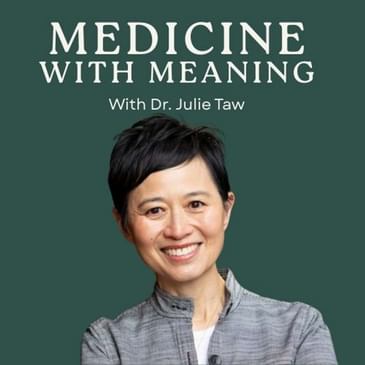
Welcome to "Medicine with Meaning." In this episode, host Dr. Julie Taw has powerful conversation about reimagining how we support our health. Instead of tackling symptoms one by one, Dr. Julie Taw guides us through the idea of designing your own health ecosystem a dynamic interplay of your nervous system, biology, daily rhythms, relationships, and sense of meaning.
You'll discover why true healing goes beyond quick fixes and targeted supplements, and how real, lasting well-being begins with stabilizing your whole system. Dr. Julie Taw breaks down the essential pillars of the Well-Being Ecosystem, from nervous system regulation to honoring personal boundaries and finding alignment in daily life. They discuss why transformation is less about dramatic overhauls and more about restoring steadiness and resilience, so you can finally feel like yourself again.
Whether you’re navigating hormonal shifts, managing stress, or simply seeking a more sustainable path to feeling good in your body, this episode invites you to step back, look at the bigger picture, and start nurturing the foundation of your health.
00:00 Holistic Health Ecosystem Explained
03:15 "Stabilization Builds Biological Resilience"
07:44 "Holistic Healing Through Nervous Balance"
10:24 "Nervous System Shapes Physiology"
14:59 "Nervous System Control Explained"
17:21 "Nervous System & Health Foundations"
21:57 "Body Thrives on Rhythmic Patterns"
25:42 "Relationships Shape Nervous System Health"
30:22 "Coherence and Health Alignment"
34:05 From Strain to Steady Resilience
35:51 "Feeling Like Yourself Again"
40:43 "Building Resilience Through Small Steps"
41:58 "Support Through the Well-Being Ecosystem"
Designing Your Health Ecosystem: Insights from "Medicine with Meaning"
What if feeling truly well isn’t just about fixing symptoms, but supporting your entire internal “ecosystem”? That’s the heart of the conversation with Dr. Julie Taw in a recent episode of "Medicine with Meaning." she unravels why so many of us feel stuck chasing the next supplement or diet protocol, while sustainable well-being remains just out of reach.
Beyond “Fixing Parts”: The Power of the Ecosystem Approach
For decades, modern health has taught us to compartmentalize: Treat hormones, then work on anxiety, then the gut. But Dr. Julie Taw urges us to zoom out. Symptoms like fatigue, anxiety, or mood shifts rarely emerge from a single cause. Instead, she explains, “The body does not operate in parts. It operates as a responsive system." True health, she believes, comes from understanding how our nervous system, biology, daily rhythms, relationships, and sense of meaning interact constantly.
This interconnected framework is what Dr. Julie Taw calls the Well-Being Ecosystem. Rather than asking, “How do I fix this hormone?” the more pivotal question becomes, “What is my system responding to, and how do I strengthen it so I can adapt and recover long-term?”
Stabilize Before You Optimize
Dr. Julie Taw agrees: Before we “optimize” our health with protocols and performance hacks, we must first stabilize. So, what does stabilization look like in practice?
According to Dr. Julie Taw, stabilization is about restoring predictability and calm to our physiological rhythms. Think steadier energy, improved sleep, reduced inflammation, and a nervous system that isn’t “bracing” for impact all day. It’s less glamorous than biohacking, but foundational. “It means the stress response isn’t constantly activated, so the body isn’t subtly bracing all day long...This is what we would call biological resilience.”
Why Do We Chase Quick Fixes?
If stabilization is so important, why do so many chase isolated solutions? Dr. Julie Taw believes we’re simply doing what we’ve been taught: searching for “the one variable to correct.” Acute problems might be solved this way, but chronic symptoms are layered and reflect accumulated strain, be it stress, hormonal shifts, or disrupted rhythms. Quick fixes are easier to market and offer hope for rapid change, but if the ecosystem remains strained, those improvements rarely last.
The Five Pillars of the Well-Being Ecosystem
Dr. Julie Taw outlines five interacting pillars that compose our health ecosystem:
Nervous System Regulation: The foundation, regulating how safe and supported our body feels. “It interprets life and translates it into physiology.”
Biology: Hormonal health, gut function, immunity, all crucial, but thrive only within a steady system.
Daily Rhythms & Environment: Consistent sleep/wake cycles, light exposure, and balanced work-rest boundaries quietly shape our biology.
Relationships & Boundaries: Emotional safety is not just mental, it’s deeply biological, impacting hormones, inflammation, and recovery.
Meaning & Alignment: Suppressing needs or living out of coherence with our values creates internal (and, in time, physiological) friction.
Making Change: Small Steps Matter
For those who want to begin, Dr. Julie Taw’s advice is simple: start by noticing where your system feels braced or strained. “What is one small signal of stability you can send your body this week?” Maybe it’s a consistent wake time, a real end to your workday, or a boundary that reduces overextension.
The journey toward well-being doesn’t need to be dramatic. As Dr. Julie Taw says, “You don’t have to overhaul your life overnight. When you strengthen the ecosystem intentionally, resilience grows quietly.”
In Summary
The body’s wisdom lies not in isolated fixes, but in tending to the relationships between its many parts. Stabilize, then optimize. Support, not strain. Start small, repeat. In this way, feeling “like yourself again” is less about chasing perfection, more about returning to a state of inner steadiness.
To learn more or connect with Dr. Julie Taw, visit julietawmd.com or connect on Instagram @julie.taw.md. And stay tuned for more on the Well-Being Ecosystem in future episodes of "Medicine with Meaning."
Show Website - https://medicinewithmeaning.com/
Dr. Julie Taw's Clinic Website - https://julietawmd.com/
Dr. Julie Taw's Instagram - @julie.taw.md
Media/Podcast Partner: TopHealth - www.tophealth.care
“Disclaimer: Informational only. Not medical advice. Consult your doctor for guidance.”