
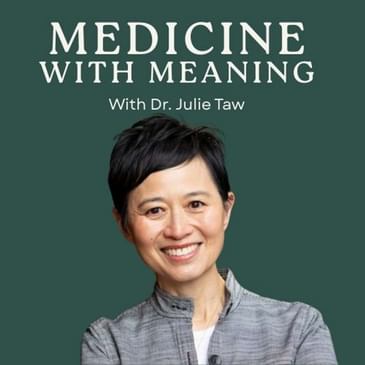
Welcome back to Medicine with Meaning. In this episode, Dr. Julie Taw explores what it truly means to view your health as an ecosystem, rather than a collection of isolated symptoms or diagnoses. She tackles the most common questions people have when starting their health journey, from feeling overwhelmed about where to begin to understanding how to prioritize what matters most. You’ll hear practical advice on finding your personal "leverage points," why meaningful change often starts with small actions, and how self-compassion and support can make all the difference, especially for high-achieving women navigating midlife transitions. Whether you’re feeling stuck, searching for clarity, or wanting to reconnect with yourself, this episode is all about moving away from perfectionism and toward a more sustainable, nurturing approach to well-being.
00:00 Introduction and health overview
04:08 Identifying key leverage points
08:10 Introducing the Well-Being Ecosystem Reset
09:34 Importance of guidance in self-discovery
13:59 Balancing ambitions with reality
18:20 Dealing with slow progress
20:58 Embracing change and new habits
25:29 Reflecting on Midlife Priorities
27:22 Embracing Midlife Transitions
32:03 Embracing a childlike mindset
36:47 Reflecting on personal well-being
38:20 Engaging with listeners on Instagram
Reimagining Health: Insights from Medicine with Meaning
In the latest episode of Medicine with Meaning, Dr. Julie Taw and Ibre invite us to rethink the very foundation of health. Rather than seeing wellbeing as a checklist of isolated tasks, they propose a compassionate, ecosystem-driven approach that acknowledges the complexity and interconnectedness of our lives. Here are the key insights and takeaways from their rich conversation.
Health Is an Ecosystem, Not a Checklist
From the outset, Dr. Julie Taw sets the tone: “Your health is not one isolated system; it’s an ecosystem.” This idea challenges the all-too common mindset of collecting health “to-dos” fix your sleep, change your diet, exercise more, meditate, set boundaries, and so on. Instead, Dr. Julie Taw encourages us to pause and listen: What is truly asking for your attention right now? The starting point is not what others say you should do, but what feels most urgent or meaningful in your own life (00:01:47).
Find the Leverage Points
When faced with a long list of goals, it's tempting to attack the loudest symptom. But Dr. Julie Taw suggests looking for "leverage points" those upstream factors that quietly influence many areas of our lives (00:04:19). For example, poor sleep may be at the root of mood swings, sugar cravings, low energy, strained relationships, and resilience to stress.
By asking “What might be influencing the greatest number of things?”, we simplify the process. Often, the highest-impact change isn't the most obvious.
Healing Is Not a Mechanical Process
A recurring theme of the episode is that effort and outcome rarely correlate in a straight line. Many of us treat our bodies like machines, do the right inputs, get the right outputs. But as Dr. Julie Taw reminds us, “Human beings are more complex than that” (00:06:21). Sometimes we’re missing a piece, sometimes healing takes longer than we wish, and sometimes progress is happening beneath the surface, even if it’s not immediately visible.
Rather than managing yourself as a project, approach your health as a relationship to nurture (00:07:54). More than supplements and strategies, self-compassion and patience often provide the missing support.
Self-Awareness Over Perfectionism
High-achieving people, especially women, tend to design plans for their “ideal lives” instead of their real lives. When we can’t measure up to these ideal standards, we feel like failures. But Dr. Julie Taw challenges this thinking: “The question isn’t what would be optimal, it’s what can I realistically sustain in this season of life?” (00:14:44). Often, it’s not about pushing harder but about letting go of perfectionism and making honest, sustainable choices.
Stabilize Before You Optimize
In a world flooded with information but starved for wisdom, Dr. Julie Taw says, “Most people don’t need more information. They need discernment.” The most important question: Does this support the life I’m trying to create? (00:23:56). Fundamental practices sleep, movement, nourishment, connection, and purpose remain the pillars for a reason. Focus on stabilizing these before reaching for novel, trendy interventions (00:25:02).
Midlife as a Time of Alignment and Dreaming
Midlife is often mistakenly seen as a time of decline. Dr. Julie Taw reframes it as a period of alignment an opportunity to ask, “What matters most now?” and, “What do I want my next act to be?” (00:25:55). As careers and caregiving roles shift, this is a powerful chance to connect with one’s own desires and dreams (00:30:36). Dreams aren’t limited by age, they’re central to wellbeing at every stage (00:31:57).
Reconnection Starts Small
If you feel disconnected from yourself, start by creating a bit of space: a quiet moment in the morning, a walk without headphones, journaling without an agenda (00:33:36). These tiny moments of attention let us hear our own voice again and reconnect with our true needs (00:34:52).
Begin with One Question
The episode closes with a practical, compassionate starting point: “What is my life trying to tell me right now?” (00:36:47). Notice what feels depleted or energized, and choose one small action to honor that insight. Sustainable change begins with small, meaningful steps, not drastic overhauls.
Medicine with Meaning invites us to a gentler, more honest, and ultimately more effective approach to wellbeing one rooted in listening, aligning, and honoring our own complex lives.
Show Website - https://medicinewithmeaning.com/
Dr. Julie Taw's Clinic Website - https://julietawmd.com/
Free Guide - https://go.julietawmd.com/reset
Dr. Julie Taw's Instagram - @julie.taw.md
Media/Podcast Partner: TopHealth - www.tophealth.care
“Disclaimer: Informational only. Not medical advice. Consult your doctor for guidance.”
Many people want to know what supplement should I take, what diet should I eat, what's another strategy. Oftentimes that's not the right approach. They just need more support. Sometimes they need more perspective or patience, more compassion, and certainly self-compassion. Many people spend years treating themselves like a project to manage. What if instead we approached ourselves as a relationship to nurture? That shift alone can change everything! Hello everyone, and welcome back to Medicine with Meaning. I'm Dr. Julie Ta, and I'm so glad you're here. Over the course of this season, we've explored so many different aspects of health and well-being, from stress, sleep, nutrition, hormones, and movement to nervous system regulation, relationships, boundaries, and the environments we create around ourselves. And while each episode has focused on a different topic, there has really been one central idea connecting all of them. Your health is not one isolated system, it's an ecosystem. Today, rather than focusing on one specific topic, I wanted to take some time to answer some questions that naturally come up when we start looking at our health through this broader lens. Because sometimes the hardest part isn't knowing more, it's knowing where to begin. So today we're going to talk about some of the questions I hear most often and hopefully help you find a little more clarity about your own health journey. Let's dive in. Dr.
SPEAKER_01Julie, I'm super excited about this episode. You know, we've talked throughout this season about looking at health as an ecosystem rather than focusing on one symptom or one diagnosis. For someone who is listening and thinking, I have so many things I need to work on. Where do I begin? What would you say?
SPEAKER_00One thing I've learned over the years is that people often overestimate how much they need to change and underestimate what deserves their attention. When we're overwhelmed, we tend to make long lists. We convince ourselves that we need to improve our sleep, fix our diet, exercise more, lose weight, meditate, reduce stress, set boundaries, and somehow do it all at once. But meaningful change rarely begins that way. Instead, I would ask what is asking for your attention right now? And not what should be important, not what someone else says is important, but rather what feels most important in your own life? Sometimes the answer is obvious. You're exhausted, you're burned out, your relationships are strained, so your body is asking for rest. Health becomes much less overwhelming when we stop trying to manage everything and start paying attention to what matters most.
SPEAKER_01Thank you for mentioning that. I I think that throughout this season this has become very clear to me as to how we want to sometimes even fix what doesn't need fixing. And so, you know, like you said, sometimes you need to rest. You don't need to fix everything, you just need to rest. And that approach is what I really appreciate about what you share, because it does make health a journey that we can sustain, because it is something that we have to work on, not work on, cultivate, right? Yeah, I was falling in the trap again. And so, Dr. Julie, we've covered so many different areas of health. How can someone tell the difference between something they should address right away or something they can work on gradually over time?
SPEAKER_00Well, of course, any concerning symptom should be evaluated appropriately, um, you know, seeking medical attention. Uh but beyond that, I often encourage people to look for what I call leverage points. Um in medicine, we sometimes focus on the loudest problem, but the loudest problem isn't always the most important one. Sometimes one issue is quietly influencing many others. Um, for instance, poor sleep can affect mood, cravings, energy, of course, um, concentration, even relationships, and certainly resilience to stress. Uh, we know loneliness can affect physical health, and chronic overwhelm can show up in dozens of different ways. So rather than asking, what is my biggest problem? I recommend asking what might be influencing the greatest number of things. In functional medicine, we call that, you know, going upstream and seeing, you know, what upstream factor can influence many um downstream issues. And so um, you know, this question, what might be influencing the greatest number of things, often reveals where to begin.
SPEAKER_01That's so interesting. So if I am battling some intense cravings, then it's, you know, my my natural reaction is to go and try to tackle that aspect, but never question myself, am I sleeping enough? Why is my body asking for more energy in the form of food, right? And what do you say to someone who feels like they've been doing all the right things? We've spoken about this, but you know, they they still don't feel well.
SPEAKER_00First, um, I tell them that I believe them. I think uh one of the hardest lessons I've learned as a physician is that effort and outcome are not always perfectly correlated. You know, it's like, you know, we want our bodies to work like a machine and it's not so simple. Or we want our health to work like a math equation. In other words, if I do all the right things, I should get the right result. But human beings are more complex than that. And sometimes we're missing a piece of the puzzle. And sometimes healing takes much longer than we'd like it to. And sometimes we're making progress that isn't visible yet. So I think, you know, many people want to know, you know, what supplement should I take, or, you know, what diet should I eat, or you know, what's another strategy? And oftentimes, you know, that's not the right approach. They just need more support. Sometimes they need more perspective or patience, more compassion, and certainly, you know, that self-compassion. And I found that many people spend years treating themselves like a project to manage. What if instead we approached ourselves as a relationship to nurture? Wow. That shift alone can change everything. And you know, I think sometimes um we demand so much of ourselves and healing just doesn't work in that very uh mechanistic fashion. Again, it goes back to perhaps allowing, allowing you know, the healing process. And when we um align with what's needed for our bodies, that is when the healing does begin. And honestly, that's one of the reasons I created the well-being ecosystem reset. And it's just um important to recognize that when we step back and see the big picture and receive the support, we will make meaningful change, you know, rather than you know having another list of things to do. And that's what this program offers, that it really is an opportunity to, you know, take a a look at ourselves and see again, you know, what is needed for us to feel good in our bodies.
SPEAKER_01Yeah, that that's true. I I mean, you know, we we treat ourselves like we are a project, and sometimes, you know, it is healing requires self-discovery and self-investigation. And I understand that you as a person are the one that has to go deep into yourself to understand yourself, but you in my case, for example, I get I can get lost in that. So having guidance and support for those moments that seem frustrating, or you know, you mentioned we're not machines. So sometimes we have the equation, and it goes back to I I think you mentioned it in some other episode where um a lot of your patients know exactly what to do, but that doesn't uh translate to being able to sustain it or to have the results they want in the time frame that they want.
SPEAKER_00So I think that being in an environment and in a program where you can be guided and reminded that you're nature, you're not a machine, but there's a course to well the the guidance is also in that self-discovery, you know. Um in the program we give we have different exercises so that you can develop more awareness. And sometimes when there's so much noise about, you know, eat this nutrition plan, work out like this, and you get a little lost in um all the health advice. And so sometimes people aren't doing the right things for what they need. And so when you touch in with yourself and your wisdom, um, it may guide you to a different place of what's needed. I think so often we live in the world of, well, I should be doing this, I should be doing that, and we're not aligning with what is really needed. I think um a really good example is just, you know, back to our high-functioning, high-performing, um, high-responsibility women, you know, we want to do it all. And um we want to, you know, be able to have these rich and full lives. But um, if we're fatigued and exhausted, well, perhaps we should listen more to our body and and see that perhaps rest is needed and and you know, doing more is not the right approach. But it's hard to tap into that wisdom when we're doing, doing, doing. Um, so it's two parts, you know, it's it's developing that self-awareness and then having the support to um take the right actions.
SPEAKER_01Yeah, we want to do it all and look good on top of it. So yeah. We need we need we definitely need support and and community, right?
SPEAKER_00Yes, and that's the other thing that the program can offer is you're doing it with other women who are um, you know, on a similar journey but different, and uh we learn about ourselves within this supportive community.
SPEAKER_01That sounds so rich. And why do you think people often struggle to maintain healthy changes even when they know exactly what they should be doing? You know, we touched on on it a little bit just now how maybe maybe they're doing the thing they might be doing the right thing, but not the right thing for them.
SPEAKER_00For them. Right? It's like the you know, wherever they're getting their information sounds like the right thing, but it may not be the right thing for them in that m moment of their life. Um, so I would say that that's one part, right? May not be the right thing for them at that time. But also behavior change is rarely a knowledge problem. You know, I think most people, you know, have all that knowledge, but maybe they're lacking capacity, right? That they really shouldn't be doing all those things. Um, and as high-achieving women, um, especially, you know, we tend to build plans for our ideal life rather than our actual life. And that is a hard pill to swallow. And when we can't sustain, you know, this ideal life, you know, we we feel like we're a failure. Um but the the question really isn't what would be optimal. The question is what can I realistically sustain in this season of life? And you know, if you're not feeling good doing all those things, then all of those things doesn't seem to be the right fit for you right now. And that requires honesty, requires self-awareness, and sometimes it requires letting go of that perfectionism. So I found that lasting change usually comes not from pushing harder, but from working with ourselves rather than against ourselves.
SPEAKER_01Yeah, and I think weight loss, I think it's a really eminent example of this where we know the math. We know that a certain amount, I can't remember, but a certain amount of calories per week, that like 7,000?
SPEAKER_00Well, it's different for everybody, right? Based on their height, their weight, their activity level. But I I know we s sometimes look at weight loss as that math equation. Is that what you're referring to?
SPEAKER_01I I meant like you know, mm-hmm, 7,000 calories equal uh a kilogram?
SPEAKER_00Well, it's three oh okay, yes. Perhaps. I know that equation in panels input. I mean 7,000. You said 7,000 calories equals minus one kilogram of weight.
SPEAKER_01I mean, it wasn't my intention to get it to a math equation here, but I I I was just thinking how it was a clear example of something that has a literal math equation. If you have a deficit of 7,000 calories per week or 3,500 calories per week, then you're you lose a pound per week. Yes, right. And so that's something that it technically, if you follow that, then you would just lose a pound a week, but that doesn't necessarily happen like that for everyone, right?
SPEAKER_00That is a beautiful example, actually. I would say that yeah, in general, if you if you stick to that formula, um you're likely to lose weight and achieve that. But there are so many other factors, and you know, um our bodies, human beings, you know, again, don't follow math equations. It doesn't even follow physics. Like biology is so much more complex. We're a living organism. And so, you know, with regards to that weight loss, there are so many other factors. Um, for instance, um inflammation in the body, you know, um, well, let me just start, you know, stress on the body and mind can cause inflammation, and that can change that equation that we talked about. Um, our hormones can change that equation. Working out too much, especially doing too much cardio, can cause stress in our body, and that'll change the equation. So, you know, there are cases that I've seen where my patients are, you know, really wanting to lose weight and they're exercising a lot and doing a lot of cardio, and that becomes counterproductive. Um so yes, you cannot approach it like a mathematic equation, and um you have to look at other factors.
SPEAKER_01And just to kind of conclude uh this idea, what what do you what's your perspective there? Like what do you suggest to your patients, or what do you do? What would you do in the program? You know, when we when we're following what we think that needs to be done, you're feeling good, but you don't see the results you want. You is it a matter of time? You do you suggest people just stick through it, find, I don't know, maybe find the other ways that the changes are are happening. What do you think?
SPEAKER_00Well, I guess number one is you have to identify what is the outcome that you're looking for, right? So in weight loss, yeah, that's very straightforward. You're you're well, it's not so straightforward. Uh there's there's weight, you know, your actual weight on the scale, there's body composition, how you feel in your clothes. You know, there's there's different factors. Um, so even weight is not so straightforward, but I was thinking of that as a more straightforward outcome. Th what I was alluding to is sort of the outcome of just feeling good, right? Not having fatigue at the end of the day, or um feeling joyful, you know, our last episode. And so you want to measure these outcomes. And if the needle is not moving, you know, the proverbial needle here for for for let's say feeling good or feeling joyful, um, then you want to assess, well, well, why is the needle not moving? And you know, same thing with the weight. And so you want to step back and look at the big picture, you know, what needs to change. And that's where the professional guidance can help, right? Um, and having you know somebody kind of look at it more objectively, you know, when you're in it, it's kind of hard to see that big picture. Or I recommend that you do step back and look at the big picture and um see what's working, what's not working. Where do I need to make some changes here? Um but I do think that having somebody guide you can be very useful when you're doing all the right things and you're still not making progress on the outcomes that you want to change, you you want to shift.
SPEAKER_01You you touched on a very good point as well. Like when we're doing when we're going through a process of change or creating new habits or we're working on ourselves in s in some shape or form and and we we're looking for a different result, we have a lot of emotions attached to the process. And having uh the professional guidance, like you said, to look at it objectively can also be very helpful because when we're so committed to something, our perception of time even changes. We feel like three days that we've been doing something feels like Longer and Sometimes we think that changes can just happen in a week. And I'm I'm sure certain changes do happen over overnight, but perhaps we put too much weight on on the outcome and not on the on the process, right?
SPEAKER_00Well, I think w what you're saying is that it's helpful to have an outside perspective, right? Um are my goals realistic? Um, you know, uh what are the benchmarks here, you know, um other people who who who go about the same journey. And no, that's where it's helpful to have um whether it's a professional or a friend or you know, somebody else, you know, having a similar experience, be your benchmark. And I think, you know, more often than not, uh, we're so demanding of ourselves, you know, especially again, going back to the the high responsibility, high performing women. Um yeah, I I think that we we do expect so much of ourselves, and it's helpful to have that outside perspective. Um, you're you're you're doing a great job, you're doing all the right things. And uh, you know, let's see what it could be different to get a better outcome. Um, but certainly at the beginning of any health journey, it it does take time to change our habits and behavior and then to get the results that we're looking for.
SPEAKER_01We've talked about nutrition, movement, sleep, stress, and so many other areas. If someone feels overwhelmed by all the health advice out there, how can they simplify it and figure out what is actually right for them?
SPEAKER_00I think we're living in a time when information is abundant, but wisdom is scarce. Again, most people don't need more information. They need discernment, they need a way to decide what actually applies to them. One of my favorite questions is does this support the life I'm trying to create? Because health is not an end unto itself. Health is meant to support a meaningful life. The best diet, exercise plan, or wellness routine isn't necessarily the one that's theoretically perfect. It's the one that helps you live your life well. Sometimes the most sophisticated thing we can do is return to what is fundamental sleep, movement, nourishment, connection, purpose. Those principles have stood the test of time for a reason.
SPEAKER_01Yeah, it's funny how sometimes we overlook those pillars that have stood the test of time, like you mentioned. Basics.
SPEAKER_00Yeah. Well it goes back to um stabilize before you optimize, right? And just, you know, get get some of the basics down first.
SPEAKER_01Yeah, have a good night's sleep, and then we can talk more. Right. And we've talked about midlife as a time of transition rather than simply a period of decline. What do you wish more women understood about this stage of life?
SPEAKER_00One thing that strikes me about midlife is that many women begin asking entirely different questions. So earlier in life, the questions are often, how do I succeed? How do I achieve? How do I care for everyone around me? Midlife often introduces new questions. What matters most now? What do I want more of? What am I ready to let go of? What's next for me? But I think the deeper invitation is often about alignment. Yes, of course there are biological changes occurring, but midlife asks us to become more intentional about how we spend our energy, our time, and our attention. And while that can feel unsettling, it can also be incredibly liberating and empowering.
SPEAKER_01So what you mentioned at the beginning, we can we think we need to do all these things, but sometimes it's a matter of paying attention to what you actually need and not what you think you need. And from what I understand, midlife can be that opportunity when you start.
SPEAKER_00Well, it's a big it's a big transition, right? I mean, of course, there's the biological aspect and our hormones are changing, but it's a real shift in our way of being, actually. I think, you know, in in our earlier life, there was such drive to achieve and succeed, and you you kind of need that to do all the things that you you need to do. Um and in midlife, you know, you still carry some of that, and so it's it's hard to kind of let go of that, but it is an opportunity to kind of be more honest with yourself and um align with what you really are needing in this moment of life. And perhaps it's a real opportunity to connect with yourself and let go of some of the expectations that people have around us. And so that's liberating. But it is a shift, and it's hard to kind of, you know, transition to this time where it gets to be all about you. And I think, you know, especially women who have been caregivers of children, um, it's always been about them. But as we enter our 50s, you know, you don't have that caregiving responsibility, and you have some space to think about what are your needs or your wants. And you you start shifting to um a place where it becomes about you and and what your desire is for this next phase of life. And that's exciting.
SPEAKER_01That is exciting. I think that in the past there was this idea of when you reach midlife, you kind of already accomplished everything. And through our conversations, I feel like I'm getting this idea of there's new discoveries to make. It's not like you've accomplished everything, but you finished a a certain aspect of your life. Not finished, but you've kind of settled the you can say that.
SPEAKER_00I would I mean, certainly in terms of caregiving, you know, when your children go off to college, you're not there in their day-to-day. And so um in some ways, you know, you you've launched them. They do they come back uh certainly uh for vacations and whatnot, but um that part of your role has has changed, right? And midlife is really a lot of role transition. And if you think about our careers, um most of us in midlife have kind of reached this peak. You know, we've worked hard to learn and and develop skills, and we're kind of like at that peak of our career. And um, you know, that that's exciting as well, and and you feel good about that. And so it does feel almost like, oh gosh, what's what's after this? It's like you peak and then you you come down. And and I I would say what you're I I think I know what you're saying. It's like, well, we don't want to like peak and then like you know go on the downhill, but it doesn't have to be that. It can be an evolution, like you know, we're evolving into our next stage. And I've been calling this act three, you know, it like in a play, there's act one, act two, and then act three is wow, you know, what do I dream of in this stage of life? What do I want to evolve into? You know, what do I want my career to look like? What do I want my life to look like? And in some regards, I think um it's it's a different kind of dreaming, you know, I think, and it's exciting. It's a it's a it's a dream that can be a little looser. Whereas the you know, act two was definitely about um building our careers, building our families. And that that took a lot of intensity as well as you know, the needs of other people. And I think act three is really about our own needs and wants and desires. And I think that's very exciting. So uh I've been, you know, really re-shifting the way we look at um midlife. And um, I think it's an empowering time.
SPEAKER_01I think it's really important or really powerful that you mentioned dreaming because there's no age for that. You can always dream. Dreams never have to be over, and perhaps they are a part of being healthy, right?
SPEAKER_00Yeah, well, um before we got on this uh episode, we were talking about how beautiful it is to be childlike, or you know, um we start the world as you know, babies, and and uh we were talking about how it's just so beautiful to be in that present moment and to be childlike. Uh look looking at the world through the lens of children is is exciting. And um part of that is children dream. And I would say we should bring that back to our midlife and allow ourselves to dream about this next phase. And it does um make it a little bit more exciting because I know midlife can feel depressing, um, but if we, you know, reframe it that way, and in some regards, you know, we become free of so many of our responsibilities that we had in that earlier part of our adulthood.
SPEAKER_01And Dr. Julian talked about how midlife is an opportunity to be more in touch with yourself, to connect with yourself deeper. But what what would you say for someone who feels like they've lost touch with themselves somewhere along the way, whether because of work, family, caregiving, or simply the demands of life, where can they begin reconnecting with themselves at midlife or on their way to midlife or past midlife?
SPEAKER_00Yeah, it applies for everyone. Well, I would begin by creating a little more space. And not necessarily more time, because many people don't have that much time, just more space. So um I talk about this a lot. Um perhaps it's just uh a few quiet moments, you know, before reaching for your phone, or or you know, put your phone aside and and have just some quiet time for yourself. Um perhaps it's you know, walking without headphones. This one's hard for me because I I love listening to books or podcasts. Um, but just you know, walking without headphones. Um, what else? Um journaling, I think, is a you know really beautiful activity and to do it without an agenda. I think you know, women have become experts at responding to everyone else's needs. And somewhere along the way, we stop hearing our own voice. And so, you know, giving ourselves space allows us to, wow, just hear our own voice, reconnecting, you know, with that voice. And it doesn't have to be in a dramatic transformation. You don't have to go away for a meditation retreat. It can happen in these small moments of attention. I think you know, that's what's missing in today's modern life. Our attention is taken up by social media, the news, or just our families. And so giving ourselves these small moments of attention can really help us reconnect with ourselves, reconnect with our needs. You know, sometimes I think you know, women aren't even used to like asking ourselves, you know, what do we need in this moment? Like that's a foreign question. But I I've experienced that myself. And so when you do this, what I've found is that you know, the the reconnection to the person, i i she's still there. And it's just giving ourselves space to connect with her.
SPEAKER_01That is beautiful. I'm taking that. Something so simple, but you're right. It blew my mind because I don't often ask myself, what do I need in this moment? And I think that alone will bring a lot of answers. And finally, Dr. Julie, we've reached the end of our episode. If someone listening today feels ready to make a change but doesn't know where to begin, what is the first step you would encourage them to take?
SPEAKER_00I would begin with a simple question. What is my life trying to tell me right now? So your own life. Not what social media is telling you, not what an expert is telling you. What is your actual life showing you? Where do you feel depleted? Where do you feel disconnected? Or where do you feel energized? Where do you feel most alive? The answers are often already there. We just move too quickly to notice them. And once you've identified what needs your attention, choose one small action that honors what you've learned. Not because small is all you can do, but because small is often how meaningful change begins and certainly how it's sustained. And if you're looking for a place to explore those questions more deeply, that's exactly why I created the well-being ecosystem reset. It's a chance to pause, reflect, connect with yourself, and begin making changes in a supportive community of women who are asking many of the same questions. Before we close today's episode, I'd love to hear from you. If there is a question about your health or well-being that we haven't explored on the podcast, visit my latest episode. I'm sorry, visit my latest post on Instagram at julie.ta.md and leave your question in the comments. You never know, it may become part of a future conversation here on Medicine with Meaning. And if you're ready to take a first step towards supporting your health more intentionally, you'll also find my free reset guide linked in the show notes. Thank you for being part of this season of Medicine with Meaning. It's been such a privilege to explore these conversations with you. And as we've talked about throughout this season, well-being isn't something we achieve once and then check it off a list. It's something we continue to create. One choice and one season of life at a time. Next time we'll bring this season to a close by looking at a question I think is worth all of us asking ourselves. What kind of life are we creating? And what do we want our well being to make possible? Until then, take good care of yourself and I'll see you next time.