
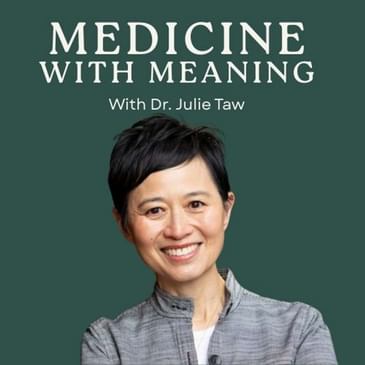
Welcome back to Medicine with Meaning. In this episode, Dr. Julie Taw takes a deep dive into the hidden ways chronic stress shapes our bodies and minds especially for women in midlife. Building on last episode’s discussion of exhaustion, Dr. Taw unpacks how ongoing demands from work, relationships, and family can leave us feeling both "wired and tired," affecting everything from sleep and appetite to hormone balance and mood. She explains why our bodies often can’t tell the difference between real and imagined stress, and how the line between functioning and flourishing can get blurred. Tune in as Dr. Taw shares practical insights on the interconnectedness of stress, hormones, and the wellbeing ecosystem and how to begin supporting your body with curiosity and compassion instead of judgment or perfectionism.
00:00 Understanding the stress response
04:52 Understanding the brain's stress response
07:02 Understanding Stress and Its Effects
12:16 Hormonal fluctuations during menstrual cycle
16:06 Stress and reproductive hormones link
17:58 Understanding women's health symptoms
22:38 Balancing multiple roles and mental load
26:33 Balancing expectations and achievements
32:09 Identifying and addressing personal needs
34:22 Interconnected body systems and effects
39:17 Understanding and Managing Stress
40:36 Closing remarks and gratitude
Insights on Chronic Stress and Women's Well-Being: Key Lessons from "Medicine with Meaning"
In the latest episode of Medicine with Meaning, Dr. Julie Taw offers a compassionate, in-depth exploration of stress, especially chronic stress and its impact on women’s health. Her discussion provides powerful insights into how our bodies respond to stress, why women in particular can be susceptible to its effects, and practical steps for cultivating resilience and recovery.
The Ubiquity of Stress And Its Complexity
As Dr. Taw explains, stress is an inevitable part of modern life, but it’s important to recognize that the human body’s stress response was designed for short bursts of activation and recovery, not the never-ending demands of today’s world 00:00:29. “When stress becomes the background noise of everyday life,” she notes, our bodies don’t distinguish between a genuine physical threat and the ongoing pressures of work, relationships, or even our own thoughts and memories 00:00:38, 00:04:52.
This means that even psychological worries can trigger the same physiological stress responses as physical danger. Over time, if we don’t allow for proper recovery, this can lead to a state where the body is always partially activated wired, but tired 00:07:23.
The Physiology of Stress
The body’s stress response is rooted in survival: adrenaline and cortisol are released, the heart rate increases, and non-essential functions like digestion and reproduction temporarily slow down. While this is lifesaving in a crisis, repeated activation without enough time to reset can disrupt sleep, appetite, blood sugar, mood, immunity, and hormone regulation 00:01:07, 00:02:00.
Women may notice symptoms like headaches, jaw tension, digestive upset, cravings, irritability, and even missed periods when stress becomes chronic 00:08:13, 00:09:18. Unfortunately, these signs are often normalized or ignored, especially when outwardly, everything appears “fine.”
Why Women Face Unique Stressors
Dr. Taw highlights that for women, the effects of stress are often amplified by hormonal fluctuations monthly cycles, perimenopause, menopause, pregnancy, and the realities of daily life where women wear multiple hats as caregivers, professionals, and partners 00:11:27, 00:12:16, 00:22:38. Hormonal shifts can make the stress response more sensitive, and at the same time, chronic stress can further disrupt hormone balance 00:16:06. This double-edged sword helps explain why so many women feel depleted, irritable, or disconnected, yet continue functioning effectively on the outside 00:29:47.
Breaking the Cycle: The Need for Recovery
One of the key takeaways from Dr. Taw’s perspective is that “recovery is not simply the absence of work” 00:23:43. Multitasking—watching TV while answering emails and planning the next day doesn’t allow the nervous system to shift into a restorative state. Women often need “permission” to rest and, just as importantly, tangible help to redistribute responsibilities 00:24:10.
You “cannot breathe your way out of a life that is asking too much of you,” Dr. Taw reminds us relaxation techniques are valuable, but so are setting boundaries, seeking support, and asking why one person is carrying so much 00:24:43.
The Wellbeing Ecosystem: A Framework for Healing
Dr. Taw encourages listeners to see health as an interconnected “ecosystem.” Wellbeing isn’t the outcome of addressing one pillar alone but arises when the neural, hormonal, nutritional, environmental, social, and existential aspects of our lives are acknowledged and supported 00:35:10. She outlines five pillars: nervous system regulation, biological foundations (sleep, nutrition, movement), daily rhythms and environment, relationships and connection, and meaning and purpose 00:35:21.
Gentle First Steps Towards Change
For anyone feeling caught in chronic stress, Dr. Taw’s advice is to start with curiosity, not judgment: notice when you feel most activated, what drains you, and which habits genuinely help you recover 00:32:09. Begin with small, doable changes maybe reducing one recurring demand, seeking medical evaluation if needed, and accepting help 00:33:50. Stabilize before trying to optimize.
Conclusion: Listening to Your Body with Compassion
Finally, Dr. Taw gently reframes symptoms as information, not evidence of weakness. The answer is rarely just “try harder.” Instead, she urges us to notice what our bodies are responding to, and make changes that create more capacity for rest, joy, and genuine wellbeing 00:39:17.
Your body is not betraying you, it is sending a message. The more we listen, the better we can support ourselves and each other.
Show Website - https://medicinewithmeaning.com/
Dr. Julie Taw's Clinic Website - https://julietawmd.com/
Free Guide - https://go.julietawmd.com/reset
Dr. Julie Taw's Instagram - @julie.taw.md
Media/Podcast Partner: TopHealth - www.tophealth.care
“Disclaimer: Informational only. Not medical advice. Consult your doctor for guidance.”